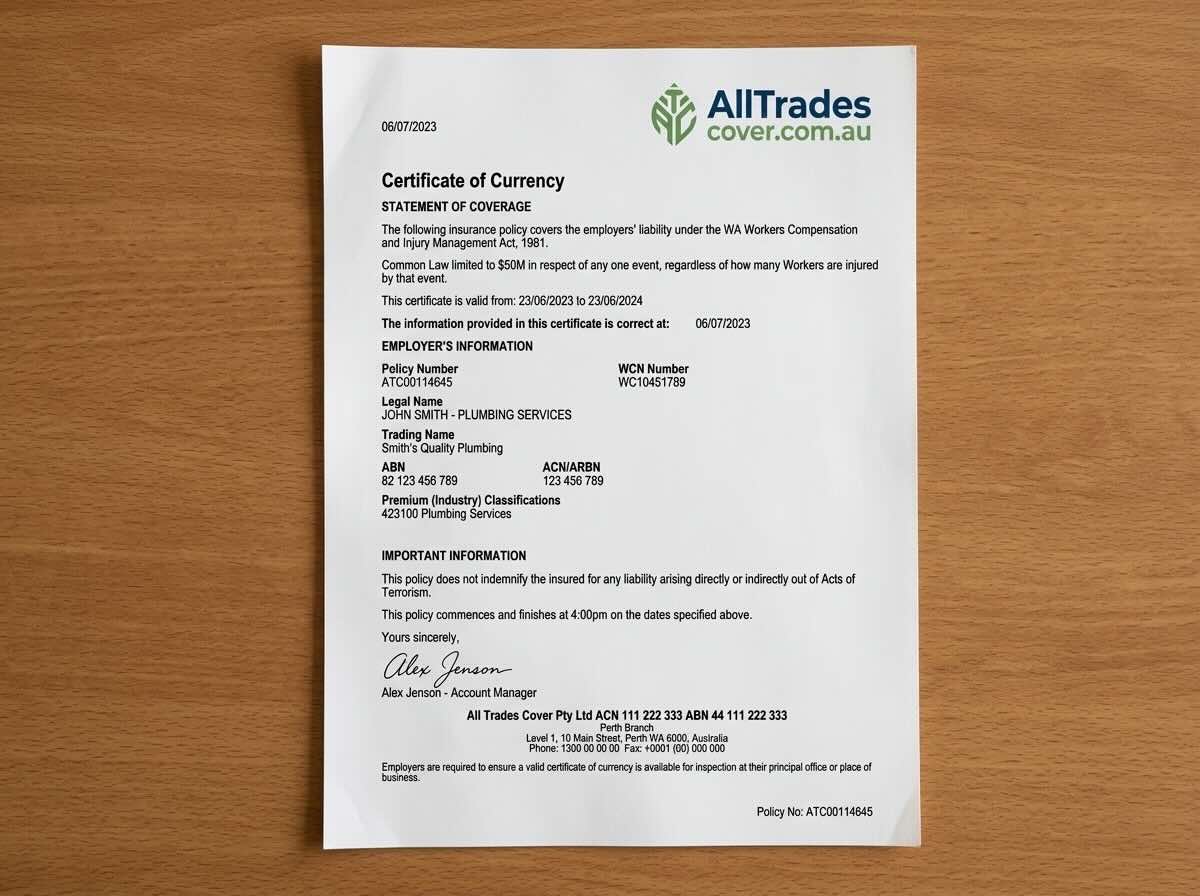





Workers Compensation Insurance is a statutory form of insurance that may help an employer meet certain costs when a worker is injured or becomes ill because of their employment.
Depending on the applicable legislation and policy, Workers Compensation Insurance may respond to:
- Weekly payments that replace part of an injured worker’s lost earnings.
- Medical, hospital and treatment expenses.
- Rehabilitation and return-to-work support.
- Travel expenses for approved medical appointments.
- Lump sum benefits for certain permanent impairments.
- Legal liability arising from a work-related injury or illness.
- Death benefits or payments to eligible dependants.
The benefits, payment periods, caps and eligibility requirements differ between states and territories. Cover is subject to the applicable workers compensation legislation, policy terms, conditions, limits, exclusions and insurer acceptance.
Quick summary
- Workers Compensation Insurance is generally compulsory when a trade business employs workers, although the exact rules are set by each state and territory.
- Cover may respond to weekly wage payments, medical expenses, rehabilitation, return-to-work support and certain legal liabilities arising from a work-related injury or illness.
- Apprentices, casual employees, part-time workers and seasonal workers may need to be included in the employer’s policy.
- Some contractors and subcontractors may be treated as workers under state legislation, even when they have an ABN and submit invoices.
- A sole trader working alone is generally not covered by Workers Compensation Insurance for their own injury and may need to consider Personal Accident and Illness Insurance separately.
- Premiums can be influenced by declared wages, the type of trade work, claims history, safety record and the applicable state scheme.
- All Trades Cover can only offer Workers Compensation Insurance in Western Australia due to licensing restrictions.
Why Is Workers Compensation Insurance Important for Trade Businesses?
Workers Compensation Insurance helps a trade business meet its legal obligations while supporting workers who suffer an accepted work-related injury or illness.
An injured employee may need time away from work, medical treatment, rehabilitation or modified duties. Without an appropriate policy, the employer may be exposed to the cost of statutory benefits, legal liabilities and possible penalties under the relevant state or territory scheme.
Workers Compensation Insurance can also support a structured recovery and return-to-work process. This may include medical treatment, physiotherapy, occupational rehabilitation, modified duties and other approved recovery services.
The policy does not remove the employer’s workplace safety responsibilities. Trade businesses still need to maintain appropriate safety systems, report incidents and meet their obligations under workplace health and safety and workers compensation legislation.
Who May Need to Be Covered?
A worker’s job title or payment method does not always determine whether Workers Compensation Insurance is required. The legal definition of a worker can depend on the state or territory and how the working arrangement operates in practice.
Employees and apprentices
Permanent, part-time and casual employees will generally need to be covered. Apprentices and paid family members working in the business may also need to be declared.
Seasonal and short-term workers
A person may still be treated as a worker even when they only work during busy periods, shutdowns, project stages or seasonal operations. A short employment period does not automatically remove the employer’s obligations.
Contractors and subcontractors
Some contractors and subcontractors may be treated as deemed workers under the applicable legislation. Factors can include who controls the work, who supplies tools, how the person is paid and whether the arrangement is mainly for their labour.
An ABN, invoice or written subcontractor agreement does not automatically decide the classification. Learn more about the difference between contractors and employees for Workers Compensation Insurance.
Sole traders working alone
A sole trader who does not employ anyone is generally not covered by Workers Compensation Insurance for their own injury or illness. A sole trader may instead consider Personal Accident and Illness Insurance, subject to the available policy terms and insurer acceptance.
The position can change as soon as the sole trader hires an apprentice, casual employee, family member or another person who may be legally classified as a worker. Our guide on whether sole traders need Workers Compensation Insurance explains this distinction in more detail.
What May Workers Compensation Insurance Cover?
Workers Compensation Insurance may cover statutory benefits and certain liabilities connected to an accepted work-related injury or illness. The exact benefits depend on the relevant scheme, policy and circumstances of the claim.
Weekly wage payments
If an employee cannot work or can only perform reduced duties, the scheme may provide weekly payments based on their pre-injury earnings. Payment rates, waiting periods, step-downs and maximum amounts are set by the applicable scheme.
Medical and hospital treatment
Cover may respond to approved medical expenses such as GP appointments, specialist treatment, hospital care, surgery, diagnostic imaging and prescribed medication.
Rehabilitation and return-to-work support
Rehabilitation may include physiotherapy, occupational therapy, approved exercise programs, recovery equipment and assistance with suitable or modified duties.
Travel for approved treatment
Reasonable travel expenses for approved appointments may be included. This can include mileage, public transport or other accepted transport costs, subject to the scheme’s applicable rates and requirements.
Permanent impairment benefits
A worker who suffers a permanent impairment may be eligible for a lump sum payment. Eligibility and payment amounts commonly depend on an independent assessment, the degree of impairment and the relevant legislation.
Legal liability and common law claims
Where permitted by the applicable state legislation, Workers Compensation Insurance may respond to certain legal costs and settlements arising from an employer’s liability for a work-related injury or illness.
Death benefits
Where a work-related injury or illness results in death, the scheme may provide funeral expenses and benefits for eligible dependants. Relationship requirements, payment amounts and caps apply.
Optional policy extensions
Depending on the insurer and jurisdiction, additional options may include journey cover or principal’s indemnity. These extensions are not automatically included and may not be available in every state or policy.
What Is Workers Compensation Insurance Not Designed to Cover?
Workers Compensation Insurance is focused on work-related injury and illness affecting employees and other people legally treated as workers. It is not designed to pay every cost a business may face after an incident.
Costs such as replacement labour, workplace improvements, fines or penalties may fall outside the policy or statutory scheme. Claims involving injury to members of the public or damage to third-party property are generally considered under Public Liability Insurance rather than Workers Compensation Insurance.
Workers Compensation Insurance
May respond when an employee or deemed worker suffers an accepted work-related injury or illness.
General focus: Wages, treatment, rehabilitation and statutory worker benefits.
Personal Accident and Illness Insurance
May provide selected benefits when a sole trader, subcontractor or business owner cannot work because of an insured injury or illness.
General focus: The insured person’s income and selected personal benefits.
Public Liability Insurance
May respond to certain claims involving third-party personal injury or property damage connected to the insured business activities.
General focus: Claims made by customers, site visitors and other third parties.
Each cover type addresses a different exposure. Holding one policy does not automatically replace the need to consider another. Read our guide comparing Workers Compensation Insurance and Public Liability Insurance.
When Might a Workers Compensation Claim Arise?
A claim may arise when a worker suffers an injury or illness that is connected to their employment and meets the requirements of the relevant workers compensation scheme.
Examples may include:
- A carpenter falling from a work platform and breaking a bone.
- A plumber suffering a back injury while lifting equipment.
- An electrician injuring a hand while carrying out installation work.
- A worker developing hearing damage following ongoing workplace noise exposure.
- An employee suffering an accepted work-related psychological injury.
- A worker requiring rehabilitation after a site or workshop incident.
These examples do not mean a claim will automatically be accepted. The insurer or relevant authority will assess the incident, medical evidence, employment connection and applicable legislation.
What Should an Employer Do After a Workplace Injury?
An employer should respond promptly, make sure the worker receives appropriate assistance and follow the reporting requirements that apply to the incident.
How the claims notification process may work
STEP 1
Respond to the incident
Arrange appropriate medical assistance and follow the business’s incident response procedures.
STEP 2
Record the details
Collect incident reports, photographs, witness details and other relevant records where appropriate.
STEP 3
Notify All Trades Cover
Contact the broking team so they can direct you to the forms and information required under your policy.
STEP 4
Insurer assessment
The insurer or relevant authority will assess the claim against the legislation, evidence and policy requirements.
All Trades Cover can support clients through the claims process, communicate with the insurer and help clients understand the information being requested. All Trades Cover does not control whether a claim is accepted or the final claim outcome.
Existing clients can use the All Trades Cover claim forms page or call 1300 826 850 after an incident.
How Much Does Workers Compensation Insurance Cost?
The cost of Workers Compensation Insurance depends on the workforce, wages, trade activities, claims record and the state scheme that applies to the business.
A starting premium may be calculated using the business’s estimated wages and the applicable industry classification rate. The final premium may also reflect the insurer’s assessment of the business and its claims experience.
Factors that may affect the premium
Declared wages
The estimated wages paid to employees and other workers who need to be declared can affect the premium.
Trade activities
The type of work performed and the risk classification applied to the business can influence the rate.
Claims history
Previous workplace injuries, claim frequency and claim costs may be considered during the assessment.
Workforce structure
Employee numbers, apprentices, casual workers and deemed contractors may affect wage declarations and policy requirements.
Safety record
The business’s safety record and injury management history may form part of the insurer’s assessment.
Operating locations
Businesses operating across multiple states may need separate policies and wage declarations for each jurisdiction.
Premiums depend on the applicable scheme, declared business information and insurer assessment. Any estimate should be checked against the business’s current circumstances.
When Should a Trade Business Review Its Cover?
A trade business should review its Workers Compensation Insurance when its workforce, wages, business activities or operating locations change.
Review your Workers Compensation Insurance when you:
Workforce and operational changes may affect the information that needs to be declared to the insurer or relevant authority.
Hire your first employee or apprentice.
Start employing casual, part-time or seasonal workers.
Engage new contractors, subcontractors or labour hire workers.
Increase wages or significantly expand the size of your crew.
Begin providing a different trade service or higher-risk activity.
Expand into another state or territory.
Experience a workplace injury or change in your claims history.
Renew your policy and confirm your actual wage figures.
A business change does not automatically mean a different policy is required. The current policy, wage declarations, worker classifications and applicable legislation should be reviewed.
Can You Use One Workers Compensation Policy Across Australia?
Workers compensation schemes are regulated separately by each Australian state and territory. A business operating in more than one jurisdiction may need separate policies, registrations or wage declarations.
The location of the business office may not be the only relevant factor. The state where workers usually perform their work, the locations of contracts and the applicable connection rules may also need to be considered.
All Trades Cover can only offer Workers Compensation Insurance in Western Australia due to licensing restrictions. Businesses operating outside Western Australia should confirm their obligations with an appropriately licensed provider and the relevant state or territory authority.
How All Trades Cover May Be Able to Help
All Trades Cover can assist Western Australian tradies, contractors and employers with Workers Compensation Insurance enquiries, policy placement and ongoing support.
Depending on the business and insurer requirements, our team may be able to assist with:
- Reviewing business activities and workforce details.
- Identifying employees, apprentices and contractors who may need to be declared.
- Preparing wage estimates and underwriting information.
- Comparing available Workers Compensation Insurance options in Western Australia.
- Assisting with insurer registration and policy documentation.
- Reviewing the policy when wages, activities or employee numbers change.
- Supporting clients through the claims process.
All Trades Cover has supported Australian tradies and contractors for more than 30 years and holds Australian Financial Services Licence 418512. The brokerage was recognised among the Insurance Business Top 10 Brokerages from 2013 to 2024.
You can also read why Workers Compensation Insurance is often managed through a broker.
Workers Compensation Insurance FAQs
Is Workers Compensation Insurance compulsory for tradies?
Workers Compensation Insurance is generally compulsory when a trade business employs workers. The exact obligation depends on the relevant state or territory legislation and the legal classification of the people working for the business.
Do I need Workers Compensation Insurance for an apprentice?
An apprentice will generally need to be included in the employer’s Workers Compensation Insurance arrangements. The apprentice’s wages and work activities should be declared in accordance with the applicable scheme.
Are casual and part-time employees covered?
Casual and part-time employees generally need to be covered in the same way as permanent employees. Their wages should be included in the employer’s wage declarations where required.
Do subcontractors need to be included?
A subcontractor may need to be included if the relevant state legislation treats them as a worker. The decision can depend on control, payment arrangements, tools, the ability to delegate work and other features of the relationship.
Does having an ABN prove someone is an independent contractor?
No. An ABN by itself does not determine whether a person is an independent contractor or a worker for workers compensation purposes. The full working arrangement needs to be considered under the applicable legislation.
Does a sole trader need Workers Compensation Insurance?
A sole trader working alone generally does not take out Workers Compensation Insurance for themselves. The position changes if the sole trader hires employees or engages people who may be treated as workers.
Can Workers Compensation Insurance cover psychological injuries?
A work-related psychological injury may be considered under a workers compensation scheme where the applicable legal, medical and employment requirements are met. Strict eligibility tests and exclusions can apply.
Does Workers Compensation Insurance cover travel to and from work?
Journey cover may be available as an optional extension in some jurisdictions or policies. It is not automatically included in every Workers Compensation Insurance arrangement.
What affects the cost of Workers Compensation Insurance?
Common premium factors include declared wages, employee numbers, trade activities, industry classification, claims history, safety record and the state scheme that applies.
What evidence should be collected after an incident?
Relevant evidence may include an incident report, photographs, video, witness details, medical information and records showing when and where the incident occurred. The insurer or relevant authority may request additional information.
Can All Trades Cover decide whether my claim is accepted?
No. The insurer or relevant workers compensation authority assesses the claim and determines the outcome. All Trades Cover can support clients through the claims process and communicate with the insurer.
Can All Trades Cover arrange Workers Compensation Insurance in every state?
No. All Trades Cover can only offer Workers Compensation Insurance in Western Australia due to licensing restrictions.
Request a Workers Compensation Insurance Quote
If you employ workers in Western Australia, All Trades Cover can review your business activities, workforce and wage information before presenting available insurance options.
Complete our online form for a Workers Compensation Insurance quote or call All Trades Cover on 1300 826 850.
General information only: This information is general only and does not take into account your objectives, financial situation or needs. Workers compensation requirements differ between states and territories. Cover is subject to applicable legislation, policy terms, conditions, limits, exclusions and insurer acceptance. All Trades Cover can only offer Workers Compensation Insurance in Western Australia due to licensing restrictions.

![How Much Does Public Liability Cost for a Sole Trader? [Tradie Guide]](https://www.alltradescover.com.au/wp-content/uploads/2026/07/public-liability-cost-sole-trader.jpg)




































![What Insurance Does a Sole Trader Need? [Guide for Tradies]](https://www.alltradescover.com.au/wp-content/uploads/2020/06/what-insurance-does-sole-trader-need.jpg)