



You may need Public Liability Insurance if it is required by your trade licence, registration, contract, tender or worksite conditions. There is no single Australia-wide rule requiring every tradie or business to hold Public Liability Insurance, so the requirements applying to your actual work should be checked.
Even where Public Liability Insurance is not legally required, it is commonly considered by sole traders, subcontractors and trade businesses that work around clients, members of the public or third-party property.
This information is general only and does not take into account your objectives, financial situation or needs. Cover is subject to policy terms, conditions, limits, exclusions and insurer acceptance.
Quick Summary
- Public Liability Insurance is not subject to one blanket legal requirement for every business or tradie in Australia.
- Some occupations and registrations do require Public Liability Insurance, so current requirements should be checked with the relevant state or territory regulator.
- Builders, principal contractors, commercial clients, government bodies and site operators may require Public Liability Insurance under a contract or site-access arrangement.
- Public Liability Insurance may respond to certain third-party injury or property damage claims arising from declared business activities, subject to the policy wording.
- Sole traders and subcontractors should not assume that another business’s policy automatically covers their own liability or satisfies their contractual obligations.
- The required liability limit and policy wording can vary between projects, so a Certificate of Currency should not be assumed to satisfy every licence, tender, contract or site requirement.
Do Tradies Need Public Liability Insurance?
Many tradies commonly consider Public Liability Insurance because their work takes place around customers, other contractors, members of the public and property they do not own.
Public Liability Insurance may respond to certain claims where a third party alleges that your declared business activities caused personal injury or property damage.
Whether you are required to hold it is a separate question. The requirement may come from legislation or licensing rules applying to a particular occupation, or from a commercial arrangement such as a contract, tender or worksite requirement.
This means two contractors performing similar work can face different Public Liability Insurance requirements depending on their state, licence, client, project or site.
Is Public Liability Insurance Compulsory in Australia?
No single law makes Public Liability Insurance compulsory for every Australian business or self-employed tradie. However, Public Liability Insurance can be compulsory for particular occupations, licence categories or registrations.
Australian Government guidance advises businesses to check which insurance they need by law because requirements can differ between occupations and jurisdictions.
Examples of Occupation-Specific Public Liability Insurance Requirements
Current requirements demonstrate why tradies should check the regulator governing their own occupation rather than relying on a general rule.
- Western Australian electrical contractors: The Western Australian Government electrical contractor licensing process requires applicants to provide a Certificate of Currency for Public Liability Insurance as part of the licence application requirements.
- Victorian licensed plumbers: The Building and Plumbing Commission states that licensed plumbers must hold the required insurance and provide evidence before a plumbing licence is issued or renewed. As at July 2026, the stated minimum Public Liability Insurance requirement is $5 million.
- Certain Victorian building practitioners: The Building and Plumbing Commission requires Public Liability Insurance for specified building practitioner categories, including certain demolishers and temporary structure practitioners.
These are examples rather than a complete list of Australian requirements. Licensing and insurance rules can change and can differ between residential and commercial work. Contractors should confirm current requirements with the regulator responsible for their occupation and jurisdiction.
Check the rule that applies to your work
If your work requires a trade licence or registration, check the current insurance requirements directly with the relevant state or territory regulator before relying on an existing policy.
Licence requirements can depend on the occupation, work category and jurisdiction. All Trades Cover does not determine whether a business satisfies its statutory licensing obligations.
Can Public Liability Insurance Be Required Even When It Is Not Compulsory by Law?
Yes. A contract, tender, builder, principal contractor, property manager, government body or worksite operator can require Public Liability Insurance even where there is no general statutory requirement for your occupation.
Australian Government guidance for contractors states that a contract should clearly identify each party’s insurance obligations and notes that contractors are often responsible for maintaining their own Public Liability Insurance.
A commercial requirement can specify more than simply whether you have a policy. It may also specify:
- The minimum Public Liability Insurance limit
- The activities that need to be insured
- The period for which the policy must remain current
- Principal’s Indemnity, where required and accepted by the insurer
- Cross Liability wording
- Waiver of Subrogation, where required and available
- Interested party or principal wording
- A project-specific Certificate of Currency
Whether these requirements can be provided depends on the policy, insurer, declared activities and contract wording.
An insurance policy or Certificate of Currency should not be assumed to satisfy every legal, licensing, contract, tender or site-access requirement.
What Does Public Liability Insurance Generally Cover?
Public Liability Insurance may respond to certain third-party personal injury or property damage claims connected with your declared business activities.
Depending on the policy and circumstances, this may include claims involving:
- Accidental damage to a client’s property
- Accidental damage to nearby third-party property or services
- Injury to a client, site visitor or member of the public
- Products supplied, sold or installed, where Products Liability is included
- Legal defence costs associated with an insured liability claim, subject to the policy wording
Public Liability Insurance does not mean every incident connected with the business will be covered. The insurer will assess any claim against the circumstances and applicable policy wording.
Activities, height or depth limits, work around certain property, subcontractor arrangements, contractual liability and property in your care, custody or control can require particular attention.
Learn more about what may be included in Public Liability Insurance.
Do Sole Traders Need Public Liability Insurance?
Sole trader status does not create one automatic Public Liability Insurance requirement. A sole trader may nevertheless need the cover because of a trade licence, client contract, site requirement or the activities performed by the business.
A sole trader working directly in customers’ homes, on building sites or at commercial properties can also have third-party liability exposure even without employees.
For example, a sole trader may be personally responsible for a claim made against the business because a sole trader and the business are not separate legal entities. Whether Public Liability Insurance may respond depends on the claim and policy wording.
See our separate guide to Public Liability Insurance for sole traders For more detail.
Do Subcontractors Need Their Own Public Liability Insurance?
A subcontractor may need their own Public Liability Insurance where it is required under their subcontract, licence or site-access conditions.
Subcontractors should not assume that the principal contractor’s or builder’s Public Liability Insurance automatically covers their own business activities or contractual obligations.
Likewise, a contractor engaging subcontractors should check how its own policy treats subcontracted work and what evidence of insurance is required from subcontractors.
The subcontract and policy wording should be checked before determining how the insurance arrangement applies.
What Should I Consider When Deciding Whether I Need Public Liability Insurance?
A useful starting point is to look at the work you perform, the places you work and the requirements imposed on your business.
1. Does Your Licence or Registration Require It?
Check the regulator responsible for your trade. Do not assume the rules applying to another trade or another state apply to your business.
2. Does a Contract Require It?
Review construction contracts, subcontract agreements, tenders and client terms for insurance schedules or clauses.
The required limit and endorsements can matter just as much as having a Public Liability Insurance policy in place.
3. Does the Site Require Evidence of Insurance?
Commercial, civil, government, mining and other controlled worksites may set insurance criteria for businesses entering or performing work at the site.
A current Certificate of Currency may be requested as evidence of the arranged insurance, but the certificate should not be assumed to prove that every activity or contractual requirement is covered.
4. Do You Work Around Third-Party People or Property?
Public Liability Insurance is commonly considered where business activities could lead to allegations of injury to another person or damage to property belonging to someone else.
This can apply to work at homes, construction sites, commercial premises, workshops, industrial facilities, civil projects and other declared locations.
5. Has the Type of Work You Perform Changed?
A policy arranged when the business first started may no longer reflect the same activities, sites, project values or contractual requirements.
New work should be disclosed where required by the policy, particularly where the business begins performing activities outside those previously declared to and accepted by the insurer.
Check your Public Liability Insurance when you:
Changes to your work, contracts or sites may affect the information your insurer needs or the insurance conditions applying to a project.
Take on a new commercial or principal-contractor agreement.
Start performing a different trade activity.
Begin work at a new type of site or facility.
Move into another state or territory.
Begin regularly using subcontractors.
Receive a contract requiring a different liability limit.
A change does not automatically mean additional cover or a higher limit is required. The business activities, contract requirements and existing policy should be reviewed against the applicable policy terms, conditions, limits and exclusions.
How Much Public Liability Insurance Do I Need?
There is no single liability limit that every tradie needs. Common available limits include $5 million, $10 million and $20 million, but the amount required can depend on contracts, licences, work locations and insurer acceptance.
For example, a project contract may specify $20 million while another client may have a different requirement. Some occupation-specific regulatory requirements also specify minimum limits.
A higher liability limit does not automatically create broader cover. The declared activities, exclusions, endorsements, limits and other policy conditions still need to be considered.
See our guide to How much Public Liability Insurance tradies may need for a detailed explanation of $5 million, $10 million and $20 million limits.
Is a Certificate of Currency Enough to Prove I Meet the Requirement?
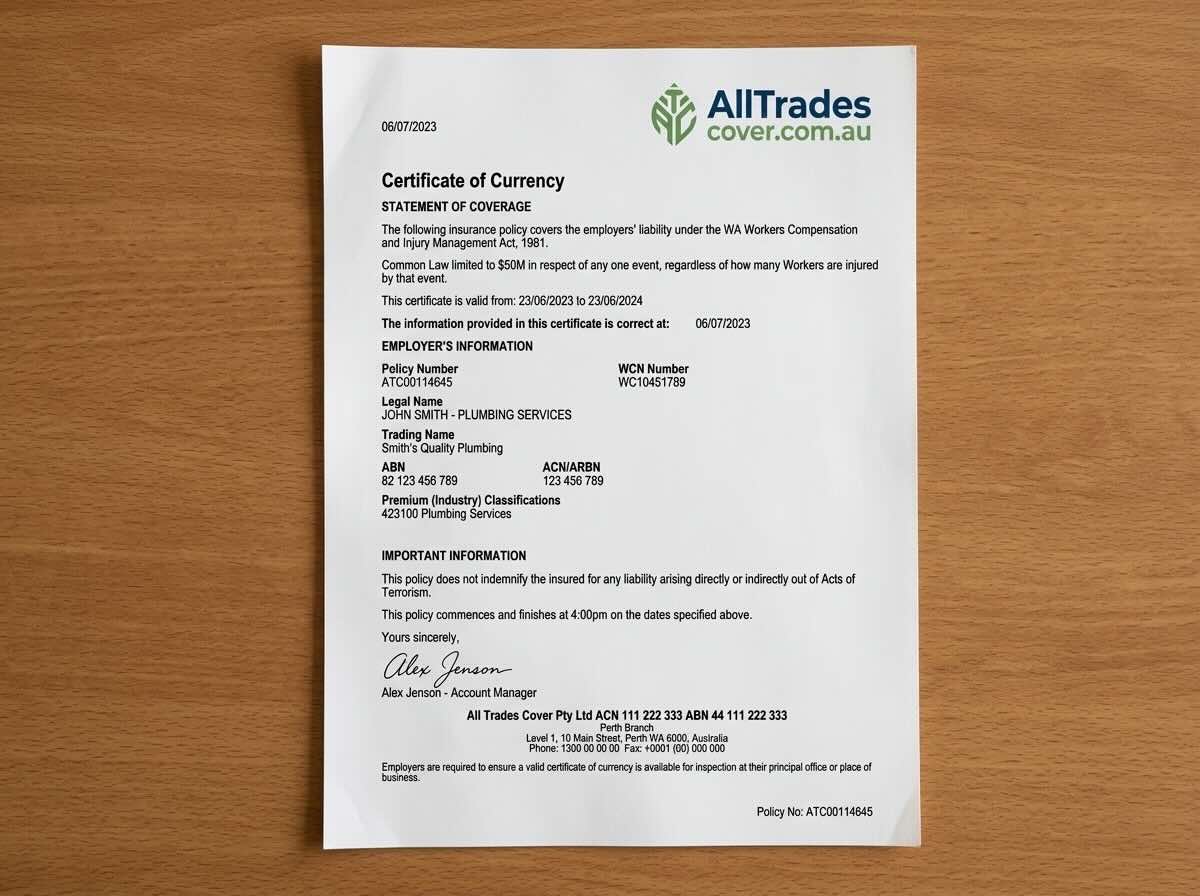
A Certificate of Currency can provide evidence of the insurance arranged, but it should not be assumed to prove that every activity, endorsement, limit or contractual requirement has been satisfied.
For example, a contract may require a $20 million liability limit, Principal’s Indemnity and specified interested-party wording. A Certificate showing only the policy number and liability limit may not answer every part of the contract insurance schedule.
Where a client or principal requests specific insurance wording, the requirement should be compared with the actual policy and referred to the insurer where an endorsement or amended documentation is required.
The key distinction
Holding Public Liability Insurance Confirms that an insurance arrangement has been made. Meeting a contract, licence or site requirement depends on whether the policy’s limit, insured activities, wording and other conditions match the requirement. One should not automatically be treated as proof of the other.
What Happens if I Do Not Have Public Liability Insurance?
The consequences depend on why the insurance was required and what happens while the business is operating.
If Public Liability Insurance is a condition of a licence or registration, operating without the required insurance may affect the business’s ability to meet the relevant regulatory requirements.
If the requirement comes from a contract or site, the contractor may be unable to meet the specified insurance condition or gain site access until the requirement is addressed.
Separately, if a third party makes a claim against an uninsured business, the business may need to deal with its own legal and financial response to that claim.
The effect of operating without insurance depends on the applicable law, contract and circumstances. Contractors should confirm legal or licensing consequences with the relevant regulator or obtain professional advice where required.
Do I Need Public Liability Insurance for Small Jobs?
The size of a job does not by itself determine whether Public Liability Insurance is required.
A small residential job may still be subject to a builder’s subcontract requirements, while a larger project may have detailed site-specific insurance conditions. A trade licence can also apply regardless of the value of an individual job.
For this reason, the contract, licence, work activity and site should be checked rather than relying only on the job value.
How We May Be Able to Help
All Trades Cover is a specialist insurance brokerage for trades, construction, mining and heavy industry. Public Liability Insurance is one of the main covers commonly considered by contractors working across residential, commercial, civil, industrial and mining projects.
Depending on the business, insurer and requirements involved, All Trades Cover may be able to help with:
- Comparing available Public Liability Insurance options
- Reviewing the insurance schedule in a contract or tender
- Checking whether the declared occupation and activities reflect the work being performed
- Reviewing requested Public Liability Insurance limits
- Approaching insurers about Principal’s Indemnity, Cross Liability, Waiver of Subrogation or other requested endorsements where available
- Arranging Certificates of Currency once the relevant cover and wording have been confirmed
- Reviewing insurance when contracts, work activities or sites change
- Supporting clients through the claims process
Insurer approval is required before amended wording or endorsements can be provided. All Trades Cover does not determine whether a policy satisfies a statutory licence, legal, contract, tender or site-access requirement.
Learn more about Public Liability Insurance Or request a quote from All Trades Cover.
Frequently Asked Questions
Is Public Liability Insurance Mandatory for Sole Traders?
Public Liability Insurance is not automatically mandatory simply because a business operates as a sole trader. It may still be required under an occupation-specific licence, contract, tender or site condition.
Is Public Liability Insurance a Legal Requirement for All Tradies?
No. There is no single Australia-wide requirement applying to every tradie. Certain occupations and registrations do have insurance requirements, so current rules should be confirmed with the regulator responsible for the relevant trade and jurisdiction.
Can My Builder Require Me to Have Public Liability Insurance?
Yes. A builder or principal contractor can include Public Liability Insurance requirements in a subcontract or project insurance schedule. The required limit, endorsements and policy conditions should be checked against the actual contract.
Can a Worksite Require Public Liability Insurance?
Yes. Site operators, principal contractors and clients may make evidence of Public Liability Insurance a condition of working at a site. The requirements can differ between sites and projects.
Do Subcontractors Need Public Liability Insurance?
Subcontractors may need Public Liability Insurance where it is required by their licence, subcontract or site conditions. They should not assume that another contractor’s policy automatically covers their own business or satisfies their insurance obligations.
Does Public Liability Insurance Cover My Employees?
Public Liability Insurance is primarily concerned with certain third-party injury and property damage liabilities. Injuries to employees are generally dealt with under Workers Compensation Insurance and applicable workers compensation legislation rather than relying on Public Liability Insurance.
Does Public Liability Insurance Cover Damage I Cause to a Customer’s Property?
Public Liability Insurance may respond to certain claims alleging accidental damage to third-party property arising from declared business activities. Whether a particular incident is covered depends on the circumstances and applicable policy terms, conditions, limits and exclusions.
How Much Public Liability Insurance Should I Have?
There is no single limit for every business. $5 million, $10 million and $20 million are common available limits, but contracts, licences, site requirements, work activities and insurer acceptance can affect the amount that needs to be considered.
Is a Certificate of Currency Proof That I Meet My Contract Requirements?
A Certificate of Currency provides evidence of the insurance arranged, but it should not be assumed to prove that every requirement in a contract has been satisfied. The liability limit, activities, insured parties, endorsements and other requested wording should also be checked.
Do I Need Public Liability Insurance if I Only Work on Residential Jobs?
Residential work does not automatically remove the need to consider Public Liability Insurance. Requirements may arise through trade licensing, builder contracts or other arrangements, and the work may still involve third-party injury or property damage exposure.
This information is general only and does not take into account your objectives, financial situation or needs. Cover is subject to policy terms, conditions, limits, exclusions and insurer acceptance.
![How Much Does Public Liability Cost for a Sole Trader? [Tradie Guide]](https://www.alltradescover.com.au/wp-content/uploads/2026/07/public-liability-cost-sole-trader.jpg)




















![What Insurance Does a Sole Trader Need? [Guide for Tradies]](https://www.alltradescover.com.au/wp-content/uploads/2020/06/what-insurance-does-sole-trader-need.jpg)


![How Do Monthly Public Liability Insurance Payments Work? [Tradie Guide]](https://www.alltradescover.com.au/wp-content/uploads/2015/10/how-monthly-payments-work-financial-consultation-meeting.webp)